How to treat rainwater to make it safe to drink
Rainwater is a natural resource that can be used for much more than watering the garden. With proper collection and treatment, rainwater can be used as drinking water. But how clean is rain really, and does it matter whether the water is collected from a rooftop or directly from the sky?
How rainwater is collected affects the contaminants it may contain and the treatment needed to make it safe to drink.
Is rainwater clean when it falls from the sky?
Rainwater forms when water vapour condenses and falls as precipitation. Although this process resembles natural distillation, the water is not completely pure.
As rain passes through the atmosphere, it can pick up dust, soot and air pollutants. Water quality therefore varies depending on location, weather conditions and air pollution levels.
Rainwater collected directly from the sky avoids contaminants from roofs and gutters. However, this does not mean the water is safe to drink, as it may still need to be tested and treated.
Collecting rainwater directly from the sky
One way to collect rainwater is to use a clean collection surface or a purpose-built rainwater collector that channels the water into a container.
To reduce the risk of contamination, the collector should be made from materials suitable for contact with drinking water. It should also be cleaned and protected from birds, insects and dirt.
Even when rain is collected directly, the collection equipment itself can contaminate the water. It is therefore important to keep the entire system clean, from collection through to storage.
Collecting rainwater from your roof
Collecting rainwater from a rooftop is often the most practical option for anyone who wants to capture larger quantities of water.
However, as rainwater runs across the roof, it can pick up contaminants such as:
- Bird droppings and other debris.
- Dust, pollen, leaves and dirt.
- Bacteria.
Rainwater collected from rooftops therefore requires particular care if it is intended for drinking.
How to treat rainwater to make it safe to drink
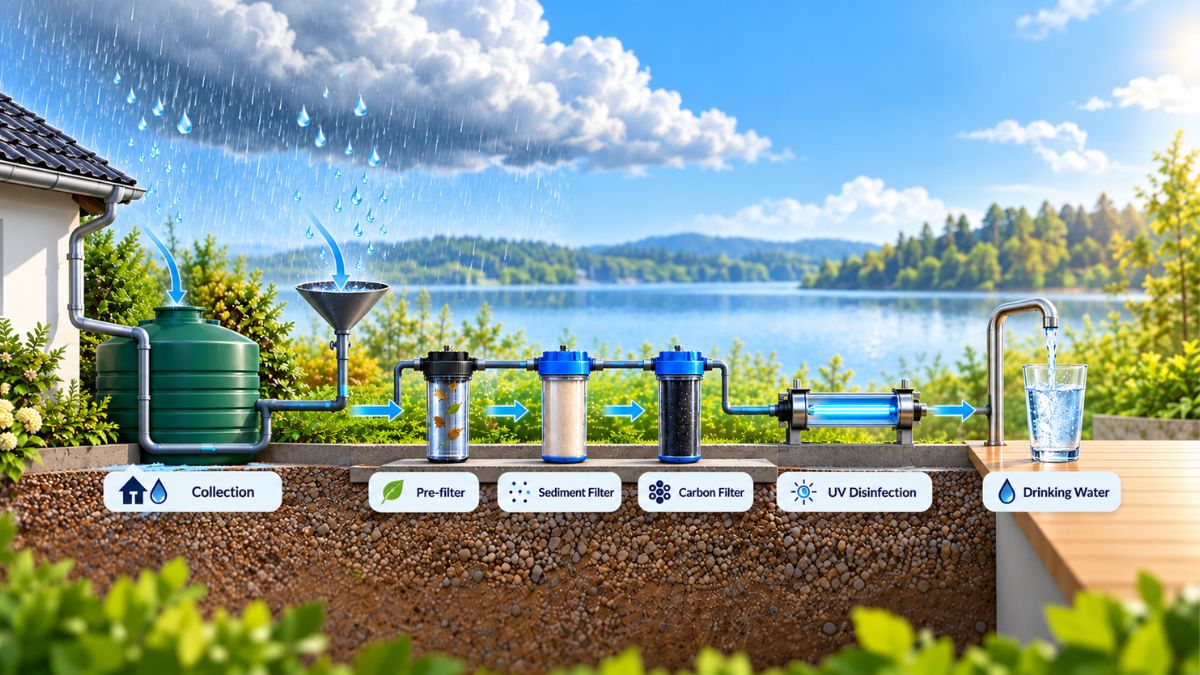
Whether rainwater is collected from a roof or directly from the sky, a carefully planned treatment process is essential.
1. Pre-filtration
The first step is to remove particles, dirt and other larger contaminants. This can be done using dedicated sediment filters or other mechanical filters.
2. Removing chemical contaminants
Activated carbon can reduce certain organic contaminants and improve the taste and smell of the water. If the water contains metals or other contaminants that are difficult to remove, additional treatment may be necessary, such as reverse osmosis.
It is important to choose filters based on the substances actually present in the water.
3. Disinfection
Rainwater can contain disease-causing microorganisms even when it looks clean.
UV treatment is one option for inactivating microorganisms, provided the water is sufficiently clear and the system is correctly sized. Other methods can also be used.
Boiling is effective against many pathogens, but it does not remove chemical contaminants or heavy metals.
4. Water quality testing
Before rainwater is used for drinking, it should be tested.
Is rainwater collected directly from the sky better than rooftop rainwater?
The main difference is that water collected from a rooftop comes into contact with more surfaces where contaminants can accumulate.
| Feature | Directly from the sky | From a rooftop |
|---|---|---|
| Air pollutants | Dust and particles | Dust and particles |
| Roofing material | No influence | Depends on the roofing material |
| Bird droppings | Low risk with clean collection equipment | Higher risk |
| Water quantity | Usually smaller amounts | Often larger amounts |
| Water treatment | Filtration and disinfection may be needed | More extensive treatment may be needed |
| Drinking water | Requires treatment | Requires treatment |
It is therefore not safe to assume that rainwater collected directly from the sky is always clean or that rooftop rainwater is always of lower quality. Both collection methods are affected by the surrounding environment, the equipment used and how the water is stored.
Can you drink rainwater after boiling it?
Boiling can make water safer from a microbiological perspective by killing disease-causing microorganisms.
However, boiling is not a complete treatment method for rainwater.
If the water contains lead, copper or other chemical contaminants, for example, these substances will not disappear when the water is boiled. In fact, some substances may become more concentrated as some of the water evaporates.
You should therefore not rely on boiling alone if the chemical quality of the water is unknown.
Can rainwater replace regular drinking water?
Yes, in certain situations, rainwater can serve as a drinking water source, provided the entire system is properly designed.
For people living on properties without a mains water connection, a well-planned rainwater system can be an alternative or a supplement to a private well.
However, an ordinary rain barrel, a basic carbon filter and a UV lamp do not automatically constitute a complete system for producing safe drinking water.
Anyone planning to use rainwater regularly for drinking and cooking should consult a water treatment specialist.
Rainwater can become drinking water with the right treatment
Collecting rainwater is a smart way to make use of natural resources. Whether you collect water directly from the sky or allow it to run off your roof, it is possible to treat it for use as drinking water.
The key difference lies in the contaminants the water may pick up and how the treatment process needs to be designed accordingly.
With suitable collection methods, proper treatment, safe storage and regular water quality testing, rainwater can become a useful source of drinking water.