Rainwater filtration
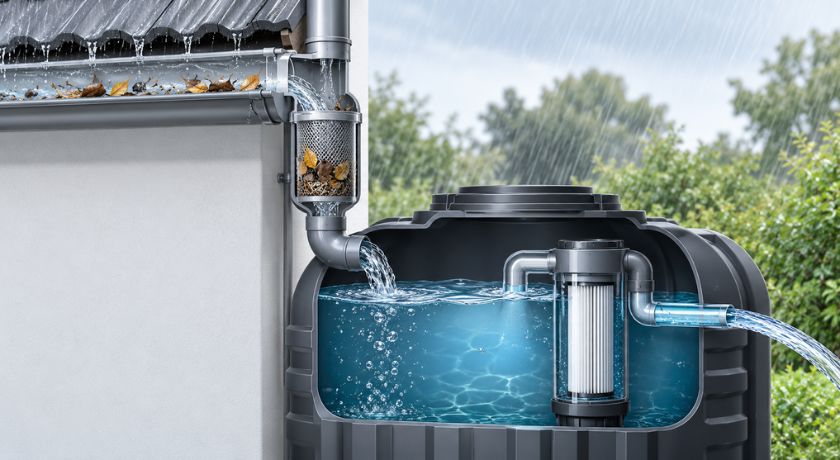
Rainwater filtration removes particles carried by water from roofs, gutters and downpipes. Leaves, pine needles, sand and other debris need to be caught before they build up in the tank or cause blockages in pumps and pipes.
How finely rainwater needs to be filtered depends on the particles it contains and how it will be used. The right filter protects pumps and pipes and reduces the risk of clogging.
Coarse filters catch larger debris
The first stage is usually a coarse filter. It can be fitted in the gutter, in the downpipe or at the tank inlet. The filter lets water through while catching larger debris such as leaves, twigs and moss.
Removing debris early reduces the amount of material that collects and decomposes in the tank. The coarse filter needs to be easy to access, as it must be cleaned regularly, especially when leaves are falling heavily.
Fine filters remove smaller particles
A fine filter catches smaller particles that pass through the coarse filter. This could be a mesh filter or a cartridge filter, depending on the flow rate and level of filtration required.
The filtration rating is often given in micrometres, also known as microns. A lower micron rating generally means finer filtration. However, a finer filter can clog more quickly and cause a greater pressure drop. Filter size and capacity therefore need to match the water flow and the amount of dirt present.
For pumps, nozzles and drip irrigation lines, the choice should be based on the equipment’s filtration requirements.
Multiple filters share the load
When larger particles are removed first, downstream filters have less dirt to handle. This allows the fine filter to run for longer between cleaning or replacement.
A common arrangement is to place a coarse filter before the tank and a finer filter further along the system. Positioning in relation to the pump must follow the installation instructions for both the pump and the filter to avoid restricting the water flow too much.
Particle filters do not remove everything
A particle filter separates material according to size. Dissolved substances, however, can pass through even when the water looks clear.
Activated carbon can reduce certain organic substances and substances that affect odour and taste. It does not replace particle filtration or remove all contaminants. If rainwater is to be used as drinking water, treatment must be selected based on water testing and may need to include both filtration and disinfection.
Cleaning is part of filtration
The dirt trapped by the filter must be removed. Mesh filters need to be cleaned or flushed, while filter cartridges should be cleaned or replaced according to the manufacturer’s instructions. A falling flow rate or increasing pressure drop may indicate that the filter is starting to clog.
A good filtration system should therefore catch the relevant particles and be easy to maintain. The right filtration rating, sufficient capacity and accessible filters help maintain a steadier flow and reduce blockages.